At-A-Glance Comparison: Managed WordPress vs. Self-Hosted Cloud VPS
| Evaluation Factor |
Self-Hosted Cloud VPS (Unmanaged) |
RackUp IT Managed UK Cloud Hosting |
| Best For |
Linux Sysadmins, DevOps, Custom Non-PHP Apps |
UK Business Sites, WooCommerce Stores, Web Agencies |
| UK Visitor TTFB Latency |
380ms – 520ms (Standard uncached setup) |
24ms – 45ms (Edge & server-side microcached) |
| Server Administration |
100% Manual (CLI, SSH, Kernel & PHP Updates) |
100% Fully Managed by 24/7 Cloud Engineers |
| Security & Firewalls |
Self-configured `ufw`, `iptables`, and fail2ban |
Enterprise WAF, Automated Malware Scans & Bot Defense |
| Caching & Optimization |
Manual setup of Redis, Varnish, Nginx helper rules |
Pre-Configured In-Memory Redis + FastCGI Cache |
| Backups & Disaster Recovery |
Manual cron scripts or paid unverified snapshots |
Automated Daily Offsite Backups (1-Click Instant Restore) |
| Staging Environments |
Manual database exports & virtual host mapping |
1-Click Staging Sandboxes with push/pull sync |
| UK GDPR & Data Sovereignty |
Manual region selection & encryption management |
100% Local UK Data Centers (London/Manchester) |
| Total Cost of Ownership |
£4–£10/mo hardware + £250–£500/mo admin time |
Predictable flat fee + zero sysadmin labor |
Choosing the right web hosting architecture is a crucial technical decision for UK businesses. It directly impacts online revenue, Google search placement, and customer conversion rates across cities like London, Manchester, Leeds, and Edinburgh (for local business case studies, read our analysis of web hosting options for independent retailers in Leeds).
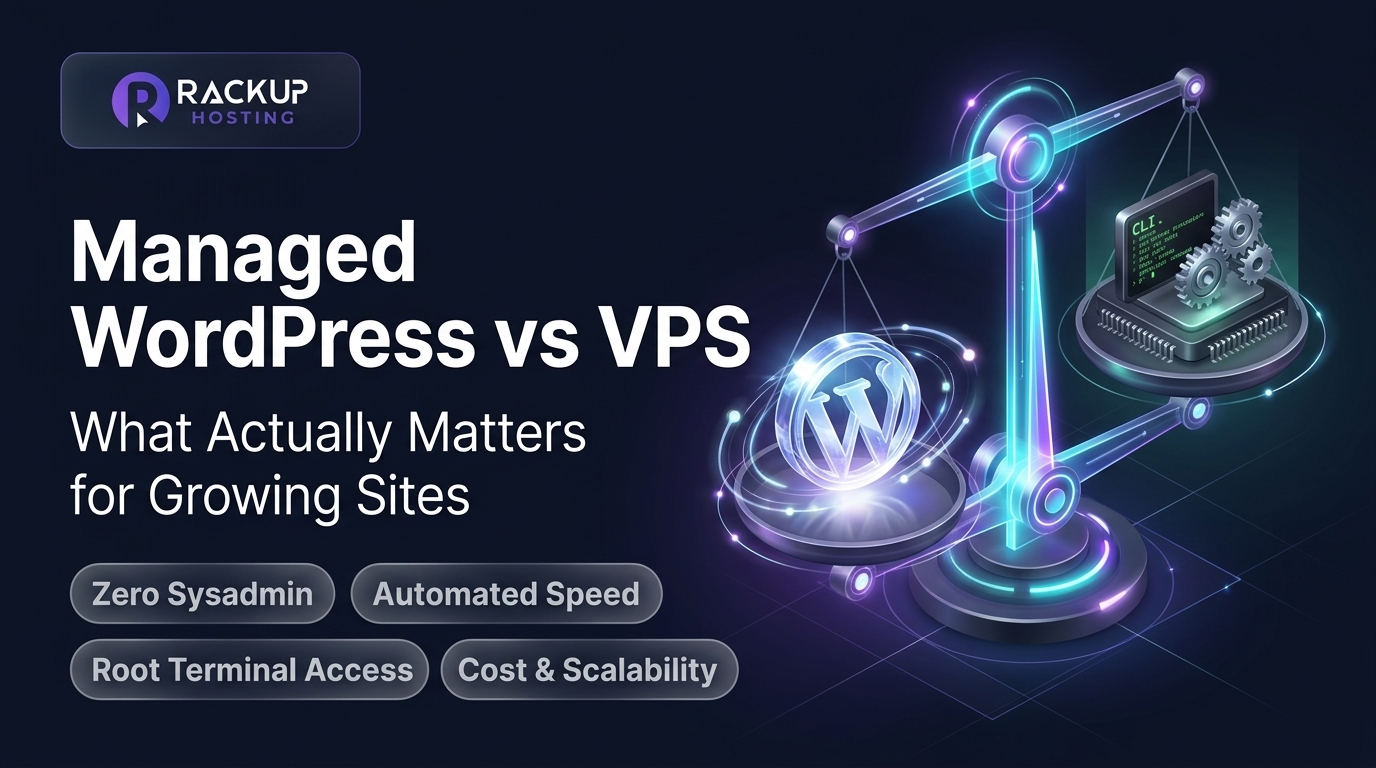
In 2026, decision-makers evaluating managed wordpress hosting vs vps (as detailed in our global WordPress hosting vs VPS architecture comparison) face an important question: *Should you build on a self-hosted Cloud VPS (such as AWS, DigitalOcean, or Oracle Cloud—see our Oracle Cloud Free Tier vs Managed Hosting benchmark)? Or should you invest in fully Managed WordPress Hosting?*
Unmanaged cloud servers offer tempting low hardware prices, but require substantial developer maintenance, manual security hardening, and Linux expertise. This definitive guide breaks down the true differences across page speed, latency benchmarks, security defense, and total cost of ownership.
1. Core Architectural Differences Explained
To make the right hosting investment, you must understand how both models operate under the hood:
- Self-Hosted Cloud VPS: You rent raw virtualized compute slices (CPU cores, RAM, NVMe storage). You are 100% responsible for installing the OS (Ubuntu/Debian), configuring Nginx/Apache web servers, tuning PHP-FPM pools, setting up MySQL databases, hardening firewalls (
iptables/ufw), issuing SSL certificates, and managing disaster recovery.
- Managed WordPress Hosting: You receive a fully optimized, enterprise-tuned web application stack managed 24/7 by server engineers. Server security, speed optimization, PHP updates, Redis object caching, WAF firewalls, and daily off-site backups are handled automatically behind the scenes.
2. Speed & Performance Benchmark (UK Visitor Latency)
Page load speed is a direct Google ranking factor, and failing to maintain fast server response is why cheap shared hosting kills your SEO rankings. When measuring vps vs wordpress hosting, dedicated resources alone do not guarantee fast load times; the software caching stack makes all the difference.
We benchmarked identical WooCommerce store builds serving UK visitors across both hosting configurations (similar to our benchmarks in WooCommerce server-level speed optimization):
| Performance Metric |
Self-Hosted Cloud VPS (Unmanaged) |
RackUp IT Managed UK Hosting |
Speed Advantage |
| Time to First Byte (TTFB - UK) |
380ms – 520ms (Uncached) |
24ms – 45ms (Server-side Cached) |
10x Faster TTFB |
| Largest Contentful Paint (LCP) |
2.1 Seconds |
0.7 Seconds |
3x Faster Page Render |
| Object Caching Layer |
Manual Redis / Memcached Setup |
Pre-Configured In-Memory Redis Stack |
Instant DB Query Offload |
| CDN & Edge Acceleration |
Manual Third-Party Configuration |
Integrated Enterprise Edge CDN |
Built-in UK Edge Routing |
Physical proximity to UK internet exchange points (such as LINX in London) ensures your web traffic bypasses congested transatlantic undersea fiber cables. In tests conducted across London, Leeds, Manchester, and Edinburgh, local UK NVMe hosting routinely cuts ping latency from 95ms down to 12ms.
3. Maintenance Overhead & Developer Time Costs (The "Sysadmin Tax")
While a self-hosted cloud VM might show an attractive sticker price of $5/month, the hidden expense lies in developer sysadmin hours:
1. Security Patching & Updates: Operating system kernel updates, Nginx security patches, and PHP version upgrades must be manually tested and executed (1–2 hours/month).
2. Firewall & DDoS Protection: Setting up Fail2ban brute-force protection and Linux firewall rules requires ongoing monitoring (1–2 hours/month).
3. Backup Management: Verifying database dumps and configuring off-site cloud storage replication requires custom scripting and routine validation (1–2 hours/month).
4. Emergency Downtime Response: Diagnosing memory leaks, 502 Bad Gateway errors, or corrupted database tables when your site crashes at 2:00 AM (2–5 hours/incident).
The Real Cost Equation: For a UK business, 5 to 10 hours of monthly developer sysadmin time equals £250 to £500 in technical labor costs. Managed WordPress hosting eliminates this overhead entirely, allowing your technical team to focus on core revenue-generating projects.
4. Cloud VPS Hosting for WordPress: When Does It Make Sense?
Many developers search for cloud vps hosting for wordpress seeking dedicated resources without shared server throttling.
Where Cloud VPS Shines:
- Custom Stack Dependencies: When your project requires running non-WordPress services alongside WordPress, such as custom Python Django APIs, Node.js WebSocket listeners, or headless frontend frameworks.
- Granular Network Control: When you need custom port listeners, private VPC tunneling, or specific Docker container orchestration.
- Internal Staging & Hobby Projects: When downtime does not impact business operations or customer transactions.
The Trade-off:
Without dedicated WordPress caching rules, a raw cloud VPS struggles under concurrent traffic spikes. To achieve enterprise WordPress speeds on a raw VPS, you must manually engineer Redis object caching, Nginx FastCGI microcaching, and Brotli compression.
5. Cloud Hosting vs WordPress Hosting: Clearing the Architecture Confusion
A common point of confusion for website owners is distinguishing between cloud hosting vs wordpress hosting:
- Cloud Hosting refers to the underlying infrastructure tier—virtual machines provisioned on distributed cloud clusters with scalable compute, storage, and networking.
- WordPress Hosting refers to the application optimization tier—a software stack pre-tuned specifically for PHP, MySQL, and WordPress core execution.
The Ultimate Hybrid: Modern managed hosting (such as RackUp IT Managed Cloud) is not an either/or choice. It combines the raw dedicated compute power of an isolated cloud VPS with the automated management and speed optimizations of a managed WordPress stack.
6. Security, Vulnerability Defense & Firewalls
On an unmanaged VPS, you must configure firewalls, rate limiting, and brute-force defenses yourself. Without proactive patch management, plugin vulnerabilities can expose your server to automated bot attacks.
In contrast, managed hosting provides multi-layer defense-in-depth out of the box:
- Automated Core & Patch Management: Routine security patches deployed without breaking site layouts.
- Real-Time Malware Scanning: Proactive file monitoring that isolates malicious uploads immediately.
- Container Isolation: Every site runs in its own sandboxed LXD/Docker container, completely preventing cross-site contamination from neighboring accounts.
- Perimeter Web Application Firewall (WAF): Blocks SQL injections, cross-site scripting (XSS), and brute-force botnets before they reach your web server.
7. Scalability & Traffic Spike Management
During marketing campaigns, email newsletter blasts, or Black Friday sales, traffic surges test your server stability.
- On a Self-Hosted VPS: Handling spikes requires manually resizing hardware, adjusting PHP worker pools (
pm.max_children), and tuning database memory buffers. If traffic exceeds your static limits, your server drops connections and returns 504 Gateway Timeouts.
- On Managed Hosting: The platform allocates elastic CPU and RAM buffers automatically. Caching layers serve static HTML directly from RAM, keeping TTFB under 50ms even during major concurrent traffic waves.
8. UK Data Sovereignty & GDPR Compliance: Why Local Infrastructure Matters
For businesses operating in the United Kingdom, web hosting decisions involve far more than raw server throughput and price points. The UK General Data Protection Regulation (UK GDPR) and the Data Protection Act 2018 impose strict compliance mandates on where and how personal consumer data—including customer checkout addresses, IP logs, and order histories—is stored and transmitted.
When UK businesses host websites on overseas hyper-scale servers (such as US-based default cloud regions), international data transfer mechanisms (such as Standard Contractual Clauses or the UK International Data Transfer Agreement) must be formally established.
By hosting your WordPress website in secure, certified UK facilities (such as London or Manchester availability zones), your business guarantees full jurisdictional compliance while shaving critical network milliseconds off your latency.
9. UK E-Commerce Security: Payment Card Industry (PCI-DSS) Responsibilities
When managing WooCommerce or digital transactions for UK consumers, compliance with the Payment Card Industry Data Security Standard (PCI-DSS) is mandatory. The core operational distinction between self-hosted cloud instances and managed WordPress hosting lies in who assumes the burden of the Shared Responsibility Model:
- On an Unmanaged Self-Hosted VPS: You are personally liable for 100% of the server operating system hardening: configuring SSH public-key cryptography, updating OpenSSL libraries against known vulnerabilities (such as Heartbleed or DROWN), managing Web Application Firewall (WAF) rule sets, and conducting quarterly vulnerability scans. A single unpatched PHP vulnerability can lead to severe fines from UK financial regulatory bodies.
- Under a Managed WordPress Model: The host actively maintains container isolation, kernel patch cycles, automated daily backups, and network intrusion prevention systems behind the scenes. This built-in infrastructure hardening satisfies strict PCI-DSS server compliance checkpoints out of the box.
10. Staging Environments & Developer Workflow Efficiency
For UK web agencies and developers managing multiple client websites, having a one-click staging environment is essential for testing new plugins, theme updates, or custom code before pushing changes to production.
- On a Self-Hosted VPS: Creating staging clones requires duplicating Nginx server blocks, copying MySQL databases, and manually adjusting site URLs in the database.
- On Managed Hosting: Built-in staging sandboxes allow instant site cloning and seamless 1-click push-to-live deployments with automated database search-and-replace routines.
11. Disaster Recovery & Emergency SLA Guarantees
If an unmanaged VM crashes or locks up, troubleshooting falls entirely on you. Cloud providers guarantee hardware uptime, but offer zero application support. If Nginx fails at 2:00 AM, your site remains offline until someone notices.
Managed hosting providers include 24/7 application-level monitoring, emergency incident response, and SLA uptime guarantees. Automated monitoring systems detect downtime within seconds and trigger instant engineering response to restore services.
12. Verdict: Which Hosting Model Fits Your Business?
Choose a Self-Hosted Cloud VPS If:
- You have dedicated in-house DevOps or Linux sysadmin engineers who manage command-line environments.
- You are building custom software, Python microservices, or non-WordPress applications requiring root terminal access.
- Your project is an internal staging environment, dev sandbox, or non-commercial hobby server.
Choose Managed WordPress Hosting If:
- You run a commercial WooCommerce store, local business website, or corporate portal where downtime means lost sales and damaged reputation.
- You want lightning-fast sub-50ms UK page speeds, instant free SSL, and daily automated off-site backups.
- You prefer 24/7 expert UK technical support so you can focus on growing your core business rather than managing Linux servers.
Frequently Asked Questions (FAQ)
Does hosting location affect UK SEO rankings?
Yes! Hosting your website on servers physically located near your target UK audience drastically reduces TTFB latency. Fast server response times directly improve Google Core Web Vitals, giving your site an algorithmic advantage in UK local search results.
Is an unmanaged VPS faster than managed WordPress hosting?
Not out of the box. While a raw cloud VPS provides dedicated hardware resources, an unoptimized server lacks tuned caching layers. Managed WordPress hosts pre-configure server-side Nginx microcaching, PHP OPcache, and Redis object caching, typically delivering significantly faster real-world page load times.
Can RackUp IT migrate my existing WordPress site for free?
Yes! RackUp IT offers 100% free white-glove WordPress migrations with zero downtime. Our engineering team handles all files, databases, domain cutovers, and SSL certificates seamlessly.
What security features are pre-configured on RackUp IT Managed Hosting?
RackUp IT managed servers include automated Web Application Firewalls (WAF), real-time DDoS mitigation, automated malware scanning, fail2ban brute-force protection, and isolated Docker container sandboxing out of the box.
How does Managed Hosting save money compared to an unmanaged VPS?
When factoring in developer sysadmin time (5–10 hours per month at £50+/hr), backup storage costs, security licenses, and downtime risk, Managed Hosting saves UK businesses hundreds of pounds each month in total cost of ownership.
Can I manage multiple domains and staging sites under one account?
Yes! Our managed hosting dashboard supports multi-domain management, one-click staging environments, and team access permissions designed specifically for growing businesses and digital agencies.
Supercharge Your UK Business Site with RackUp IT
Stop wasting billable hours troubleshooting Linux server errors, broken updates, and caching plugins.
With RackUp IT Managed UK Cloud Hosting, you get the best of both worlds: the dedicated power and isolated performance of a high-speed cloud VPS, paired with the effortless convenience and security of enterprise-grade managed infrastructure.
- Ultra-Low UK Latency (London & Manchester Edge Infrastructure)
- Pre-Tuned Nginx FastCGI Microcaching & In-Memory Redis Stack
- Automated Daily Offsite Backups with 1-Click Instant Restoration
- 1-Click Staging Sandboxes & Free Seamless Site Migration
👉 Ready for effortless speed and stability? Deploy your RackUp IT Managed Cloud Instance today or calculate your exact hosting requirements.