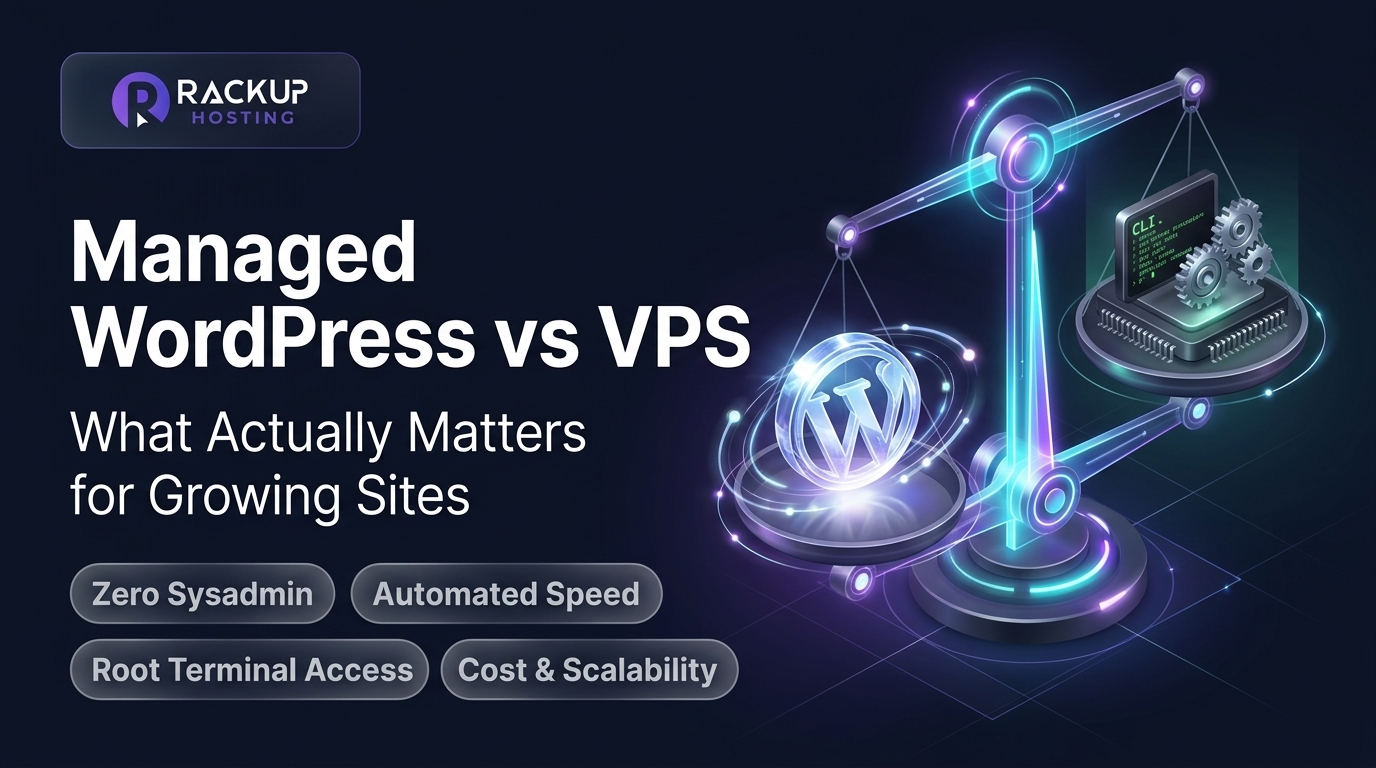
Managed WordPress vs. Self-Managed Cloud VPS
Evaluation Factor | Self-Managed Cloud VPS | Managed WordPress Hosting (RackUp IT) |
|---|
Primary Audience | Sysadmins, DevOps engineers, Linux developers | Business owners, agencies, publishers, WooCommerce stores |
Server Administration | 100% manual (CLI, SSH, OS updates, security hardening) | 100% managed by cloud engineers & automated toolsets |
Root Access & Customization | Full root access; install any OS, package, or daemon | Application-level access (SFTP, SSH, Git, WP-CLI); no raw OS root |
Caching & Optimization | Manual setup of Redis, Varnish, Nginx helper rules | Pre-configured server-side microcaching & Redis Object Cache |
Security & Firewalls | Self-managed iptables, fail2ban, and ModSecurity rules | Enterprise WAF, automated bot filtering, malware scans & SSL |
Backups & Disaster Recovery | Manual cron jobs, rsync scripts, or paid hypervisor snapshots | Automated daily offsite backups with 1-click instant rollback |
Staging & Workflows | Manual cloning, search-and-replace, virtual host mapping | 1-click staging environments with seamless push/pull sync |
Monthly Financial Investment | Low entry price ($5–$15/mo) + high maintenance hours | Flat, transparent pricing ($15–$35+/mo) + zero admin time |
The Core Dilemma: Managed WordPress Hosting vs. Cloud VPS Explained
*(If your audience is based in the United Kingdom, review our dedicated UK Business Guide to Managed WordPress Hosting vs Cloud VPS for regional London/Manchester latency benchmarks and UK GDPR data sovereignty rules.)*
Every growing business reaches a critical digital crossroad: your shared hosting plan is buckling under peak traffic, pages are loading at a crawl, and Google Core Web Vitals reports are flashing red because cheap shared hosting kills Google SEO rankings.
You know you need dedicated server resources. But when researching your upgrade paths, you run straight into the industry debate: Managed WordPress hosting vs VPS.
To make the right investment, you must first understand the fundamental architectural difference:
graph TD
    subgraph "Self-Managed Cloud VPS"
        A[Raw Cloud Hypervisor] --> B[Linux OS / Kernel]
        B --> C[Web Server Nginx / Apache]
        C --> D[PHP Runtime & Extensions]
        D --> E[MySQL / MariaDB Database]
        E --> F[WordPress Application]
        style B fill:#f9d5e5,stroke:#333
        style C fill:#f9d5e5,stroke:#333
        style D fill:#f9d5e5,stroke:#333
        style E fill:#f9d5e5,stroke:#333
        style F fill:#eeac99,stroke:#333
    end

    subgraph "Managed WordPress Cloud Hosting"
        G[Enterprise Cloud Infrastructure] --> H[Automated Container Sandbox]
        H --> I[Pre-Tuned Nginx + Redis + PHP 8.x Stack]
        I --> J[Hardened WAF & Edge CDN Layer]
        J --> K[Optimized WordPress Application]
        style H fill:#d5e8d4,stroke:#333
        style I fill:#d5e8d4,stroke:#333
        style J fill:#d5e8d4,stroke:#333
        style K fill:#cdeb8b,stroke:#333
    end
What is a Self-Managed Cloud VPS?
A Virtual Private Server (VPS) is a virtual machine provisioned on top of a physical parent server using hypervisor technology (KVM, VMware, or LXD). You receive a dedicated slice of compute power: guaranteed CPU cores, dedicated RAM, and isolated NVMe disk space.
However, an unmanaged or self-hosted cloud VPS delivers an empty Linux distribution (such as Ubuntu or Debian). From that blank shell prompt, you must configure the firewall, install Nginx, tune PHP-FPM pools, configure MySQL, issue SSL certificates, and set up your own backup routines.
What is Managed WordPress Hosting?
Managed WordPress hosting is a specialized hosting environment engineered exclusively to deliver peak performance, bulletproof security, and hands-off maintenance for WordPress.
Rather than handing you a blank terminal, the hosting provider takes full operational responsibility for the entire underlying stack. The server environment is already pre-configured with modern caching mechanisms, intrusion prevention systems, automated backups, and dedicated WordPress staging environments. You focus purely on publishing content, driving marketing campaigns, and generating sales.
Total Cost of Ownership: The Hidden "$5/Month" Sysadmin Tax
The primary attraction of a self-managed VPS is the sticker price. Providers like DigitalOcean, Linode, and Oracle advertise basic VPS droplets (we benchmarked this in our Oracle Cloud Free Tier vs Managed VPS comparison) for $5 or $6 per month, while managed WordPress hosts charge $25 to $35+ per month.
On a spreadsheet, opting for the self-managed VPS appears to save $240 to $300 every year. In reality, that comparison ignores the single biggest expense in web infrastructure: human developer time.
xychart-beta
    title "Monthly Total Cost of Ownership (TCO): VPS vs Managed WP"
    x-axis ["Sticker Price ($)", "10 Hrs Sysadmin Time ($50/hr)", "Security & Backup Tools ($)", "Total Real Monthly Cost ($)"]
    y-axis "USD ($)" 0 --> 600
    bar [6, 500, 25, 531]
    bar [29, 0, 0, 29]
Calculating the "Sysadmin Tax"
When you operate a self-hosted cloud VPS for WordPress, you inherit the role of a 24/7 Linux systems administrator. Consider the monthly operational tasks required to keep a production server alive:
1. Linux Security & Kernel Patching: Applying security updates, testing package dependencies, and restarting critical services (1–2 hours/mo).
2. PHP-FPM Pool & OPcache Tuning: Adjusting pm.max_children, pm.start_servers, and memory limits to prevent out-of-memory (OOM) fatal crashes during traffic spikes (2–3 hours/mo).
3. Database Maintenance & Index Optimization: Cleaning overhead, repairing corrupted MySQL tables, and optimizing slow database queries (1–2 hours/mo).
4. Firewall & Intrusion Management: Auditing fail2ban logs, blocking malicious brute-force IP ranges on wp-login.php, and configuring SSL/TLS ciphers (1–2 hours/mo).
5. Emergency Incident Response: Debugging fatal 502 Bad Gateway errors, high CPU load spikes, or corrupted files at 2:00 AM (2–5 hours/incident).
> The Real Math: If your time (or your developer's billable rate) is worth $50 to $100 per hour, spending just 5 hours per month managing server tasks turns that "$6/month VPS" into a $250 to $500 monthly expenditure.
Unless your core business model is Linux infrastructure management, self-hosting WordPress on an unmanaged VPS is one of the most expensive ways to save twenty dollars.
When comparing cloud hosting vs wordpress hosting, speed is often the decisive factor (for concrete tuning steps, explore our guide on how to speed up WordPress with NGINX microcaching and OPcache). Search engines and consumers demand sub-second load times; studies consistently show that a 1-second delay in page load time slashes e-commerce conversions by 7%—an issue we explore in-depth in our WooCommerce speed optimization guide.
How do the two hosting models compare under real-world load?
1. The Resource Isolation Advantage
Both modern cloud VPS instances and high-tier managed WordPress platforms offer guaranteed isolated resources. Unlike entry-level shared hosting where a noisy neighbor can monopolize CPU cycles, a VPS or containerized managed instance ensures your RAM and CPU cores belong exclusively to your site.
2. The Configuration Gap
Having dedicated CPU cores is only half the battle. WordPress is built on PHP and MySQL, meaning raw compute power cannot overcome poor server-level software architecture.
On a Self-Managed VPS: You start with vanilla configurations. A default Nginx and PHP installation will choke when hit by 100 concurrent visitors unless you have manually configured:
FastCGI Microcaching for anonymous page requests.
Redis Object Caching in-memory to offload recurring database queries.
HTTP/3 and Brotli compression modules.
MySQL buffer pool allocations tuned specifically to your RAM footprint.
On Managed WordPress Hosting: The software stack is engineered from the hypervisor level up specifically for WordPress execution. With RackUp IT Managed Cloud, enterprise-grade caching layers, Redis persistent object caching, and PHP 8.x JIT compilers are active from the second your container boots.
The result? Out-of-the-box Time to First Byte (TTFB) under 180ms without touching a single line of Linux configuration code.
Security, Backups & Disaster Recovery: Who Wakes Up at 2:00 AM?
WordPress powers over 43% of the internet, making it the primary target for automated botnets, credential stuffers, and zero-day vulnerability exploits.
When evaluating managed wordpress hosting vs self managed, your security architecture dictates whether an attack is a non-event or an existential disaster.
The Self-Managed VPS Security Model
When you deploy WordPress on a raw VPS:
You are the Chief Information Security Officer: You must configure SSH key pairs, disable password authentication, harden wp-config.php, implement restrictive file permissions (chmod 755/644), and configure firewall rules (ufw or iptables).
Brute-Force Vulnerability: If you fail to configure rate-limiting for xmlrpc.php and wp-login.php, automated botnets can exhaust your server's RAM in minutes.
Disaster Recovery: If malware breaches an unpatched plugin, you must manually isolate the server, audit access logs, purge malicious scripts from the database, and attempt manual recovery from your offsite backups.
The Managed WordPress Hosting Security Model
Managed hosting implements Defense-in-Depth at the infrastructure perimeter:
Web Application Firewall (WAF): Real-time inspection of incoming HTTP/HTTPS traffic, automatically blocking SQL injection, Cross-Site Scripting (XSS), and known WordPress core exploits before they reach your application.
Automated Daily Backups & 1-Click Rollback: Backups are stored in physically isolated, redundant storage facilities. If a theme or plugin update breaks your production site, you restore the entire environment with a single click in less than 60 seconds.
Malware Removal Guarantees: Reputable managed hosting providers monitor file integrity automatically and provide professional remediation if an exploit ever occurs.
One of the strongest arguments made by advocates of a raw VPS is full root access. But do you actually need root access to build and scale a high-performance WordPress site?
flowchart LR
    A[What Developers Think They Need: Root Access] --> B[Edit Nginx Vhosts]
    A --> C[Manage PHP Extensions]
    A --> D[Run Database Backups]
    A --> E[Staging & Git Deployment]

    F[What Modern Managed Hosting Delivers] --> G[WP-CLI & SSH Access]
    F --> H[1-Click Staging & Push/Pull Sync]
    F --> I[Automated SSL & Redis Management]
    F --> J[Git Integration & Webhooks]
When Root Access is a Requirement:
You genuinely need an unmanaged cloud VPS if:
Your architecture requires running non-WordPress services alongside your site (such as custom Node.js microservices, Python Django daemons, or Elasticsearch clusters).
You require non-standard Linux packages or custom PHP extensions that managed hosting providers blacklist for security reasons.
You are building a complex multi-tenant SaaS architecture where you need full control over network routing, Docker orchestration, and custom port listeners.
For 95% of web development agencies, freelancers, and businesses, raw root access is an unnecessary liability that introduces human error.
Modern managed WordPress platforms provide developer-friendly tools without the operational risk:
WP-CLI via SSH: Execute database migrations, plugin batch operations, and search-and-replace routines instantly from the command line.
1-Click Staging Environments: Clone your production site into an isolated sandbox, test core/theme updates safely, and push changes back to production without downtime or database overwrites.
Git Version Control & Deployment Hooks: Trigger automated deployments straight from GitHub or GitLab repositories.
Detailed Head-to-Head Comparison Matrix
Feature / Capability | Unmanaged Cloud VPS | Managed WordPress Hosting (RackUp IT) |
|---|
Initial Deployment Speed | 2–6 hours (OS installation, LEMP setup, hardening) | Under 60 seconds (Instant automated provisioning) |
WordPress Core & Security Updates | Manual or unmonitored background cron | Automated with visual regression testing & safe rollbacks |
Server-Level Caching | Manual (requires configuring Nginx FastCGI + Redis) | Built-in Enterprise Page Caching + Redis Object Cache |
SSL Certificate Management | Manual Certbot CLI setup, cron renewal debugging | Fully automated wildcard SSL issuance & zero-touch renewal |
PHP Version Switching | CLI package installation, socket reconfiguration | 1-Click switching (PHP 8.1, 8.2, 8.3) via dashboard |
Staging Environment | Manual database dump, URL search-replace, vhost creation | 1-Click sandbox creation with selective database sync |
Traffic Spike Scalability | Fixed resources; manual vertical resizing required | Automatic container scaling & burst capacity handling |
Technical Support | Infrastructure only (ping, power, network hardware) | 24/7 WordPress-specialized cloud engineers |
Malware Cleanup | Self-remediation or expensive third-party security hire | Proactive perimeter defense & automated containment |
Decision Framework: Which Should You Choose?
Choose a Self-Managed Cloud VPS if:
You are an experienced Linux systems administrator or DevOps engineer who enjoys command-line server management.
You are hosting custom applications, APIs, or non-PHP stacks alongside your WordPress installation.
You have strict compliance requirements demanding custom operating system kernels or bespoke network firewalls.
You have a dedicated internal IT department with the bandwidth to handle 24/7 uptime monitoring and incident response.
Choose Managed WordPress Hosting if:
You run a mission-critical business, e-commerce store (WooCommerce), or high-traffic publication where downtime directly costs revenue.
You want lightning-fast page loading speeds without spending weeks learning Nginx configuration files and Redis tuning.
You value developer sanity: you want 1-click staging, automated daily backups, and instant rollback safety nets.
You realize that saving $20/month on hosting is false economy if it consumes hours of billable client work or executive focus.
Frequently Asked Questions (FAQ)
Is a VPS faster than managed WordPress hosting?
Not by default. While a raw cloud VPS provides dedicated CPU and RAM, an unoptimized Linux server running default Apache and MySQL will perform significantly slower than managed WordPress hosting. Managed hosts engineer their entire stack with tuned Nginx microcaching, PHP OPcache, and Redis object caching, resulting in much faster real-world TTFB (Time to First Byte).
Can I run WordPress on an unmanaged VPS without coding skills?
It is strongly discouraged. Running an unmanaged VPS requires working knowledge of the Linux command line (SSH), bash scripting, file permissions, firewall rules, and database administration. Without these skills, your server is vulnerable to malware infections, misconfigurations, and catastrophic data loss.
What is the difference between cloud hosting and WordPress hosting?
"Cloud hosting" refers to the underlying infrastructure layer—virtual machines running on distributed cloud clusters (like AWS, Google Cloud, or high-performance NVMe cloud nodes). "WordPress hosting" refers to the software management layer configured specifically for WordPress applications. High-end managed WordPress hosts actually run on top of cloud hosting architecture.
Can I install plugins on managed WordPress hosting?
Yes. You have full access to install any WordPress themes and plugins you choose. Some managed hosting providers may maintain a short list of banned plugins (typically poorly coded caching plugins, duplicate backup scripts, or server-straining link checkers) because those functions are already handled natively at the server level with far higher performance.
How hard is it to migrate from a self-managed VPS to managed hosting?
Migrating to a managed host like RackUp IT is completely seamless. Our cloud migration engineers handle the entire process—including database transfers, file verification, SSL provisioning, and DNS cutover—with zero downtime for your users.
Stop wasting billable hours troubleshooting Linux server errors, broken updates, and caching plugins.
With RackUp IT Managed WordPress Cloud Hosting, you get the best of both worlds: the raw power and dedicated resource isolation of a high-performance cloud VPS, paired with the effortless convenience and security of enterprise-grade managed infrastructure.
Blazing Fast NVMe Storage & Isolated Cloud Containers
Pre-Tuned Nginx Microcaching & Redis Object Cache
Automated Daily Backups with 1-Click Instant Restoration
1-Click Staging Sandboxes & Free Seamless Migration
👉 Ready for effortless speed and stability? Deploy your RackUp IT Managed Cloud Instance today or book a free consultation with our cloud hosting architects.